
Categories
Tags
-
#HUMAN RESOURCES
#HR Business Partner
#HR METRICS
#Secret to success and happy life
#women
#leadership
#board members
#Finance
#Account and Managment
#
#pension
#fund
#supply chain
#customer service
#talent conference
#talent certification
#goverances
#risk
#compliance
#personal assistant
#executive
#african pa
#assistant
#certified hr
#project manager
#hr analyst
#hr digital marketing
#analyst
#hr management
#talent management
#managing
#arrangment
#risk specialist
#market analyst
#proffessionals
#cyber security
#talent management strategies
#talent managment
#portfolio
#information system
#planning strategy
#afrcan pa award
#credit risk
#chartered portfolio
#public finances
#chartered economist
##Customer Service
##hr #humanresources #digitalhr #digitalmigration
#Talent
#employees
#performances
#employee
#retention
#management
#benefits
#engagement myths
#hr metrics & analytics
#hr metric &analytics
#human metrics & analytics
#performance management
#human resource
#performances management
##marketing
#sales
##certified risk analyst
##talent management
##human resources
#human resource innovation
##human resource#digital human resource
#digital transformation
##human resource#digital human resource.
##Pensionfunds
##risk&compliance
##Governance
#risk&compliance
##compliance
##Auditing
##finance
##accounting
##Business
##management
Archives
6 Skills for People Analytics Success
-
by Jonathan Ferrar, November 21, 2017
#1 – Business Acumen
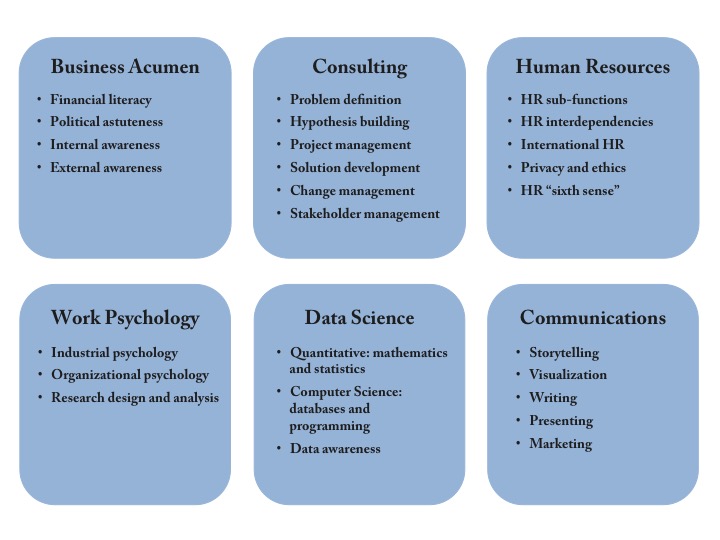
Business acumen refers to quickness and ability at interpreting and resolving business challenges. It’s great if everyone in the team has some degree of business acumen, but it’s especially important in the leader. In the figure are listed the sub-skills that fall under this category; financial literacy, political astuteness, internal (organizational) awareness and external (marketplace) awareness.
#2 – Consulting Skills
Consulting skills repeatedly arose in discussions with analytics directors about the skills most needed for success. Digging deeper revealed that when these experts were discussing consulting skills, they were referring to the ability to clearly define problems, create hypotheses about the causes of problems, propose solutions, and manage the organizational change process while keeping stakeholders satisfied and the project on track.
#3 – Human Resources
The workforce analytics leader often came from a background other than HR, but someone in the team always had deep HR experience. This was usually in either one of the functional specializations of HR (such as recruitment or learning), HR strategy, or international human resources. These people often have a sixth sense for what is right and wrong when it comes to decision-making about people. Make sure you have these skills on your team!
#4 – Work Psychology
Work psychologists bring the science to the analytics in HR. Industrial psychologists have a deep understanding of the causes of common individual level performance issues. Organisational psychologists focus on team and business unit productivity. Work psychologists can save you years of work (this is no exaggeration) investigating the causes of common HR problems, just by simply telling you what the scientific literature says about the causes of common HR issues.
#5 – Data science
Data science in workforce analytics describes two broad skill sets. The first set of skills is quantitative, and refers to the ability to build mathematical and statistical models of organizational processes like attrition. The second broad area is computer science. These skills involve managing databases and programming. People with these skills are the data experts, those who can extract the data from multiple systems and shape it into a structure suited for analysis by your mathematicians and statisticians.
#6 – Communications
The best analyses in HR analytics fall flat when they are not communicated well. We were advised time and again that successful projects tended to have a common denominator – they were all well communicated. Communication skills should be a requirement from everyone in the team. You should look to ensure at least one person has a strength in areas including storytelling, visualization, presenting, writing, and marketing. If necessary, you may decide to look for an external communications expert.
Summary
In summary, workforce analytics projects present challenges that are best met with a team with diverse skills. Our research suggests that the Six Skills for Success cover the required skills to achieve successful business outcomes.
These skills do not mean you need six people (or multiples of six), nor do you need the people physically employed in your organisation. Other chapters in the book talk about the skills most needed by the leader plus how to get skills from elsewhere in your organisation and how to outsource skills into your team on an ‘as need’ basis from outside your company.